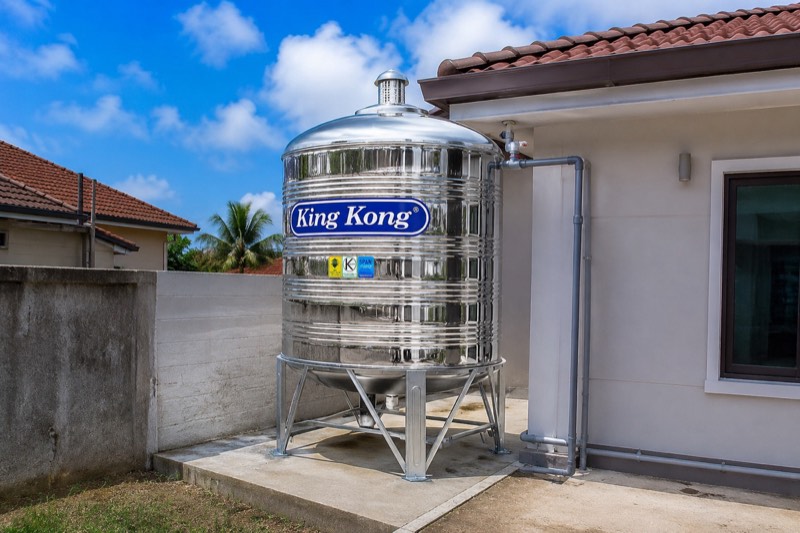
This is the most common decision Malaysian homeowners face when it is time to replace a tank: stick with a cheap poly water tank, or upgrade to a stainless steel water tank that lasts far longer? Both have their place — and the right answer depends on how long you plan to stay in that house.
We install both types every single week. This is an honest comparison drawn from real field experience, not brochure claims.
Durability: The Stainless Steel Water Tank Wins by a Mile
Poly (polyethylene) is plastic — and plastic under the Malaysian sun turns brittle. After a few years of daily UV exposure, a poly tank body starts to develop hairline cracks, the colour fades, and the surface turns chalky. A stainless steel water tank has none of these problems: the steel stays stable through heat, rain and constant temperature swings, year after year.
From our own experience in the field, poly tanks in fully exposed locations usually start showing problems within a far shorter period than a stainless steel tank of the same age. The material simply is not built to fight our climate for the long haul.
Water Quality: The Stainless Steel Water Tank Advantage
The inner surface of stainless steel is smooth and non-absorbent — algae struggles to take hold and cleaning is straightforward. Poly, on the other hand, especially the light-coloured tanks exposed to sunlight, grows algae inside much faster. Darker colours (the classic black water tank) reduce the algae problem but absorb heat — the water comes out lukewarm in the middle of the day.
For families who are sensitive to the taste and smell of their water, this difference becomes very noticeable once the tank is a few years old. It is one of those things you only appreciate after living with both.
Water Tank Price: Poly Wins Upfront, Stainless Steel Wins Long-Term
A poly water tank really is cheaper at the shop — that is its genuine advantage. But the full calculation has to account for lifespan: if a poly tank needs replacing more often (with installation labour paid each time), the total long-term spend usually ends up higher than one stainless steel tank that lasts far longer.
As a current price reference from us: the King Kong Water Tank 1000L stainless steel, fully installed at RM 2,914 — inclusive of complete installation and a 6-month installation warranty. Installation-only (your own tank, poly or stainless): RM 1,350.
When a Poly Water Tank Still Makes Sense
Honestly, poly has its place: a tight immediate budget, temporary use (a short-term rental house, a project site), or a tank location that is fully shaded from the sun. If your current poly tank is still in good shape and only a few years old — there is no need to change it; maintain it and clean it on a regular schedule.
One more situation: a second water storage tank for outdoor use — watering the garden, washing the car, or a rain water harvesting tank. For non-drinking use like this, poly is reasonable and perfectly adequate; save the stainless steel budget for the main tank of the house.
Water Tank Installation: How Poly and Stainless Steel Jobs Differ
Many people assume water tank installation is the same job regardless of type — in reality there are differences that affect the long-term result. A poly tank is light and easy to lift, but its body flexes; if the base is not level, the poly floor "follows" the surface and the water load concentrates on one section. A stainless steel tank is rigid — a tilted base puts stress on the bottom welds, so the base-levelling work has to be done properly before the tank ever goes up.
Our standard process is the same for both types: inspect and level the water tank base, raise the tank, connect the inlet and outlet pipes with new fittings (we never recycle old fittings), install and adjust the float valve, then fill the tank completely and test every connection before handover. For replacement jobs, we bring the old tank down and dispose of it as part of the work — you do not have to arrange anything.
Most installations are finished the same day. The jobs that take longer are cases with a damaged base or a rusted stand that need extra work — and we tell you that during the site visit, not after the work has started.
Aftercare: Water Tank Cleaning Routines & Keeping the Cover Sealed
Whichever you choose, simple aftercare extends the life of both types. The most basic rule: keep the water tank cover properly sealed at all times. An open cover invites light (algae grows fast), leaves, dust and insects — the number one cause of murky water that usually gets blamed on the tank itself.
Schedule regular internal water tank cleaning — empty the tank, brush the inner surfaces without strong-smelling detergents, rinse and refill. A poly tank exposed to light needs cleaning more often than stainless steel, because algae takes hold on its surface much more easily.
While you are cleaning, spend a minute checking the water tank float valve and the pipe connections — a float that is starting to loosen or a seal that is starting to harden is far cheaper to replace early than to wait for an overflow or a leak.
The Verdict: Choose Your Water Tank Based on How Long You Are Staying
Your own home, planning to stay long → stainless steel, no need to think twice. A rental house or temporary use → poly is adequate. Not sure about the condition of your existing tank → book a free site visit with Abang Tank; we assess it and give you a straight recommendation, anywhere in Malaysia.
A simple way to think about it: divide the price by the number of years you expect to use it. The tank that costs more but lasts far longer usually works out cheaper per year than the cheap tank that has to be replaced repeatedly — and every replacement comes with installation labour plus a full day of disrupted water supply.
FAQ — stainless steel water tank
Does a stainless steel water tank rust?
Proper-grade stainless steel does not rust under normal use. The parts to watch are the welds and pipe connections — which is exactly why installation quality matters.
Can I switch from poly to stainless using the same base?
Usually yes — we check the base condition during the site visit. If the base is still solid and level, the replacement is a same-day job.
Is a blue water tank the same thing as a poly tank?
Yes — the "blue water tank" is the common name for the blue-coloured poly tank, the type most commonly installed by developers.
How long does water tank installation take?
For a standard replacement with an existing base in good condition, the work is done the same day — old tank down, new tank up, pipes connected, tested. Cases needing base work or a new stand will be flagged during the site visit.