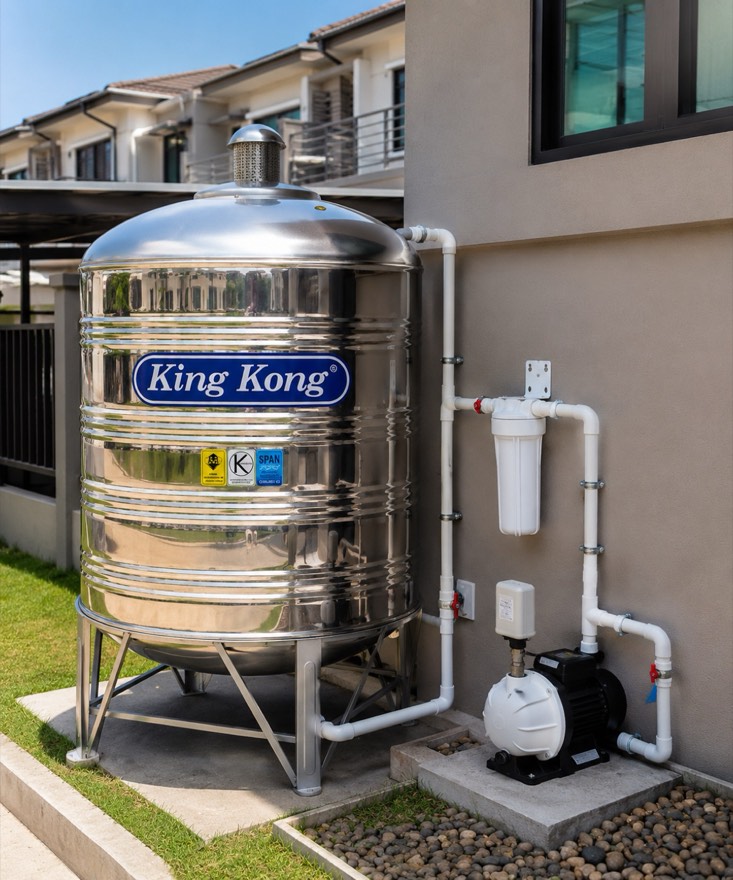
A shower that trickles like light rain, a washing machine that takes forever to fill — weak water pressure is one of the most common household complaints in Malaysia. The good news: the cause can almost always be identified, and the fix is not necessarily expensive.
Here are five solutions organised by root cause, arranged from the simplest to the ones involving installation work — go through them in order, because plenty of people jump straight to buying a pump when the actual culprit is just a half-closed valve.
1. Check For Half-Closed Valves & Pipes
The simplest and most frequently missed cause: a gate valve under the tank or along the pipe run that was never fully reopened — usually after previous maintenance work. Make sure every valve along the supply line is fully open.
Quick way to check: open the tap nearest to the tank and compare its flow with the tap furthest away. If even the nearest one is weak, the problem is at the valve or the main pipe from the tank; if only the far one is weak, there is most likely a restriction somewhere along the middle of the run. This two-minute test saves a lot of guesswork.
2. Clean The Filters & Tap Heads
Sediment and dirt accumulate in shower head filters, tap aerators and inlet strainers. If pressure is weak at only one or two water points, open up and clean the filters at those points first before blaming the whole system.
Practical tip: soak the shower head or aerator in vinegar for a few hours to dissolve scale, scrub gently with a soft brush, then reinstall. If pressure returns to normal at that point after cleaning, you have found your cause — no need to touch any other part of the system.
3. Check The Tank Water Level & Float Valve
Gravity pressure depends on the height of the water inside the tank. If the float valve shuts off too early, the tank’s working level stays low and pressure drops. Adjust the float arm so the tank fills to the level it should.
Signs of a low working level: the sound of water entering the tank stops early even though the level is not high yet, or pressure is good in the morning but fades quickly once a few water points are used at the same time. Open the water tank cover and watch where the float valve shuts off — if it is well below the overflow pipe, there is room to adjust it upwards.
4. Raise The Tank Height
Every additional metre of height gives roughly 0.1 bar of pressure. If your tank sits low — for example on a base at the same roof level as the upstairs bathroom — raising it on a taller stand into an elevated water tank setup gives a permanent improvement with zero electricity.
This work involves a new stand and pipe adjustments — check with a licensed plumber to make sure the structure can carry it.
A common real-world scenario: a terrace house with an extra bathroom added upstairs after renovation. The original tank was installed for a single-storey layout, so the new upstairs shower gets very weak pressure. The fix is not to jump straight to a pump — raise the tank to the correct height first, then reassess. Many people are surprised that gravity alone solves it.
5. Install A Booster Pump
When gravity has been maximised but pressure is still not enough — especially double-storey houses with a heated shower upstairs — a booster pump is the definitive solution. The pump is installed after the tank and boosts pressure to the whole house automatically: a sensor detects flow when a tap opens, the pump kicks in, and pressure rises instantly at every water point.
At Abang Tank, pumps are offered through the Pakej Lengkap for tank buyers — the King Kong 1000L tank, a Hitachi pump and a 6-layer filter installed in one go, so your whole system is sorted in a single job. During the free site visit we measure your actual pressure and advise whether you need a pump or whether gravity adjustments alone are enough.
Pressure Still Weak? Sometimes The Answer Is Replacing The Water Tank
There are cases where the real culprit is the tank itself: an old tank outlet clogged with years of sediment, a tank that was installed too low from the very start, or an ageing poly tank that has deformed until the outlet and float valve positions are compromised.
If you are already planning to replace your water tank, that is the best time to fix your pressure once and for all — the stand height gets set to your house’s actual requirements, the outlet pipe size is chosen correctly, and the pipe routing is tidied up. With Abang Tank, the King Kong Water Tank 1000L stainless steel is RM 2,914 fully installed — an all-in price — with a 6-month installation warranty. If you use your own tank, the installation-only fee is just RM 1,350.
FAQ — elevated water tank
Why is my water pressure weak only in the evenings?
During peak hours, incoming mains pressure drops because of simultaneous usage in your area. A storage tank kept at full level and at the correct height reduces this effect — your house draws on gravity-fed storage, not the mains directly.
Do I need a pump for a single-storey house?
Usually not — the correct tank height is enough for a single-storey house. Pumps are more relevant for multi-storey homes or high-powered heated shower users.
Can a pump be installed on my existing tank?
Yes, subject to the condition of your existing tank and piping. We check during the site visit and recommend a suitable configuration.
Read Next
→ Water Tank Float Valve: How It Works, Common Problems & When to Replace→ Home Water Tank System: Function, Components & How It Works