Most of us never think about our home’s water system — until the day the taps run dry or the ceiling turns wet. In truth, understanding the basics of your home water tank system helps you spot problems early, communicate precisely with your plumber, and make smart upgrade decisions — without needing to become a plumber yourself.
Here is a simple component-by-component guide — from the inlet pipe all the way to your shower.
The Function Of A Water Tank In A Home System
A storage water tank serves three functions. First, supply buffering: when the mains supply is disrupted or pressure drops during peak hours, your house draws on stored water. Second, pressure stabilising: a tank positioned at height provides consistent gravity pressure, independent of the ups and downs of incoming supply. Third, separation: sediment from the mains settles in the tank instead of flowing straight into your house piping.
A simple example of why that buffer matters: when there is a scheduled supply disruption in your area, a house with a full storage tank can still bathe, cook and wash as usual for the duration — while direct-feed houses go dry instantly. That same stored water is what saves your morning when a main pipe bursts down the road without notice.
Key Components Of The System
From the entry point to your house piping, this is your water’s journey. Get to know each component — when a problem comes up later, you can point straight at the right part instead of just saying "no water":
- Incoming supply pipe + main valve — the first control point after the water meter.
- Float valve — controls tank filling automatically.
- Storage tank — poly, stainless steel or fibre; sized to your family’s needs.
- Overflow pipe — the safety route when the float valve fails.
- Outlet pipe + gate valve — from the tank into the house distribution system.
- Booster pump (optional) — for homes that need extra pressure.
- Filter (optional) — treats water before it enters the house piping.
Why Height & Gravity Design Matter
Most Malaysian home systems rely on gravity: the tank is placed high so the water’s own weight pushes it down into the pipes below. Every metre of height contributes roughly 0.1 bar of pressure — which is why the tank’s position determines your shower experience every morning, and why two neighbouring houses with identical tanks can have vastly different pressure.
Good design accounts for the highest water point in the house (the upstairs shower), pipe distances, and simultaneous usage. This is planning work done before installation — not after problems appear.
The Home Water Tank Bypass: What It Does & When To Use It
A well-designed system has one more component that rarely gets mentioned: the home water tank bypass arrangement. It is a set of valves that lets mains supply skip the tank and flow straight into the house piping. Its purpose: when the tank needs emptying for cleaning or repair, your house still has water — open the bypass, close the tank route, and the work proceeds without the house going dry.
What matters is the valve positions after the work is done. The correct daily configuration: the route through the tank open, the bypass closed. A bypass left open causes two silent problems — erratic pressure that follows the ups and downs of the mains, and water sitting stagnant in the tank without circulation, which degrades its quality by the time you draw on it again.
If your house has no bypass arrangement, it can be added during a tank replacement job — the most economical time, since the plumber is already working on the same pipe run. Just mention it during the site visit and we include it in the work plan from the start.
Home Water Tank Size: Match It To Your Family
The right size is a balance between daily needs and how long a buffer you want. A large family with heavy simultaneous usage needs more storage; a small two-person household does not need a giant tank whose water turns over too slowly. A 1000 litre water tank is the most commonly installed size for family homes in Malaysia — enough for daily use plus a comfortable buffer when supply is disrupted.
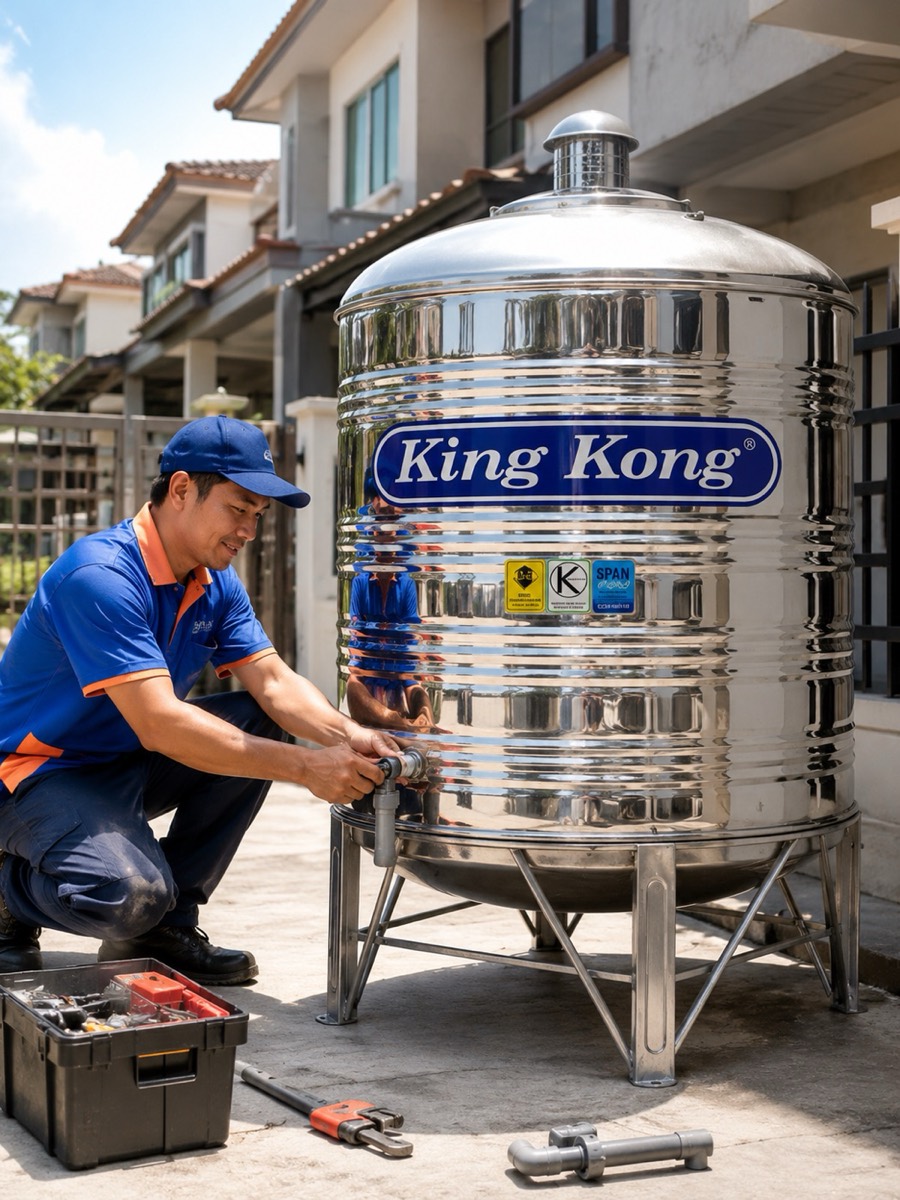
Material is part of the system decision too. A stainless steel water tank lasts far longer than poly, does not turn brittle under the Malaysian sun, and is easier to clean. That is why our flagship product is the King Kong Water Tank 1000L stainless steel — RM 2,914 fully installed, an all-in price covering the tank and installation by a licensed plumber, with a 6-month installation warranty.
System Upkeep: A Quick Checklist
A properly installed system does not demand much attention — but periodic checks prevent surprises: check the water level and float valve every few months, clean the tank on schedule (more often for poly), watch for changes in pressure or water quality, and investigate any new noise or dripping.
Make it a routine that is easy to remember: every time you clear the drains or do outdoor chores, spend five minutes looking over the tank as well. Most major problems — a leaking tank, a failed float valve, a rusting stand — begin as small signs visible to the naked eye months before they turn into an emergency.
Want your whole system inspected by a licensed plumber? The Abang Tank site visit is free — we check the tank, float valve, base and pressure, then give you a straight recommendation. If your system is fine, we tell you it is fine.
FAQ — water tank for house
My house has no tank — direct from the mains. Is that okay?
A direct-feed system works when mains pressure is good, but you have no buffer when supply is disrupted. Most Malaysian homes choose a storage tank for exactly this reason.
How often should a water tank be cleaned?
General guideline: inspect once a year, clean whenever there is noticeable sediment. Poly tanks and areas with murky supply need a more frequent schedule than stainless steel tanks.
What is the most worthwhile upgrade for an old system?
It depends on your problem: rusty/brittle tank — replace with stainless steel; weak pressure — height or a pump; murky water — a filter. Our free site visit helps you set the priorities.
Read Next
→ How To Increase Water Pressure From Your Tank: 5 Fixes By Cause→ Types of Water Tanks in Malaysia: Stainless Steel, Poly & Fibreglass — Which Is Best?