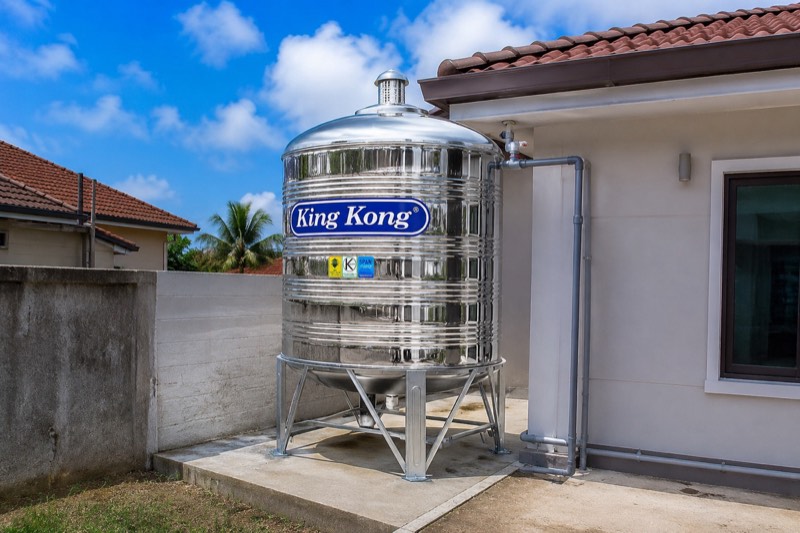
The right water tank size is the difference between a house that stays calm through a supply disruption and a house that runs dry by midday. Too small — your stored water runs out before the supply comes back. Too big — you pay extra for capacity you never use, and the water sits in the tank for too long.
Let us work out the right size for your family the simplest way possible.
How Many Litres Is One Water Tank?
Home water tanks in Malaysia are usually labelled in gallons or litres. The common conversions: 200 gallons is roughly 900 litres, 300 gallons is around 1,350 litres, and 400 gallons is around 1,800 litres. The most popular size for a family home is around 1000 litres.
The number on the tank is the maximum capacity — the actual working level is slightly lower, because the float valve shuts off the inlet before the tank is completely full.
How to Calculate What Your Family Needs
The simple calculation: average water usage per person in Malaysia is around 200-230 litres a day (showers, laundry, cooking, toilets). For comfortable storage, aim for a tank that can hold at least one full day of usage for the whole household.
Remember too: during a supply disruption, usage can be managed — put off the laundry and the garden watering, and one day of storage can be stretched into two. So this calculation is not about living exactly as normal with no supply; it is about keeping your family covered on the essentials without disruption.
- Family of 2-3: roughly 600-700 litres a day → a 1000 litre tank is comfortable.
- Family of 4-5: roughly 900-1,150 litres a day → a 1000 litre tank covers one day of careful usage; consider 1,800 litres (400 gallons) if your area gets frequent supply disruptions.
- Large family / two-generation household: consider two tanks, or a 400 gallon size and above.
Other Factors Besides Household Size
Does your area get frequent water rationing or low pressure? Add a buffer — go one size up from your basic calculation. Homes with a big garden, a fish pond or a high-capacity washing machine also use more.
Site space matters too: a 1000 litre water tank is around 1.1 metres in diameter and needs a stand or base that can carry the full weight — close to one tonne when full. This is why we inspect the site during the free site visit before confirming the size.
Think about your five-year plan as well. A young family that will grow, or a house planned for room rentals, should calculate based on future occupants — because changing tanks twice within a few years costs far more than choosing the right size once.
Working Out the Capacity of Your Existing Tank
Want to replace your tank but not sure what size is currently up there? The easiest way: look for the capacity plate or stamp on the tank body — most manufacturers print the size in gallons or litres near the top cover or on the side. If the label has faded, measure it yourself.
For a round tank: measure the diameter and height in metres, then calculate the volume with the cylinder formula — 3.14 times (half the diameter, squared) times the height, then times 1,000 to get litres. Example: a tank 1.1 metres in diameter and 1.1 metres tall gives roughly 1,000 litres. For a rectangular tank, simply multiply length, width and height in metres, then multiply by 1,000.
This calculation is useful for more than buying a replacement — it is also how you check whether the "400 gallons" your previous installer promised is really 400 gallons. When we do a site visit, this measurement is one of the first things we verify.
Water Tank Stands & Site Space: How Size Affects Installation
Tank size is not just about capacity — it determines the structural requirements. A full 1000 litre tank weighs close to one tonne; go up to 1,800 litres and the load nearly doubles. The water tank stand or concrete base must be designed for the full weight, not the empty-tank weight that two people can easily lift.
Space also has to be calculated with working clearance in mind: at least enough room for the installer to move around the tank during installation, access to the top cover for future cleaning, and a route for the overflow pipe to reach a drain. A tank squeezed into a space that fits it exactly looks space-efficient, but it makes every maintenance job after that a struggle.
If your site space is limited but your water needs are high, there are middle paths — for example two medium tanks in different locations, or a rectangular tank that fits into a corner. These are exactly the options we discuss during the site visit, because the best answer depends on your own house.
The Popular Size: Why 1000 Litres Became the Standard
For most Malaysian terrace and semi-D homes, 1000 litres is the sweet spot between capacity, price and physical size. That is why the main Abang Tank package is the King Kong Water Tank 1000L stainless steel — fully installed at RM 2,914, including a 6-month installation warranty.
Not sure which size? During the free site visit, we calculate your family usage, check the water pressure in your area and the condition of the site — and only then recommend the right size, not the most expensive one.
And if the numbers show your home genuinely needs more than 1000 litres, we say so plainly and lay out the options — we never force a big requirement into the standard size just because that is the package on hand.
FAQ — water tank size
Is a 1000 litre water tank enough for a family of 5?
For normal usage, yes — it covers one day of careful usage. If your area gets frequent extended supply disruptions, consider the 400 gallon size (around 1,800 litres).
What is the difference between gallons and litres on a tank label?
One gallon is roughly 4.5 litres. A "200 gallon" tank means around 900 litres of capacity.
Is there any downside to going too big?
Two: higher cost, and if your usage is low, water sits stagnant in the tank for too long. Choose a size based on actual usage, not simply the biggest available.
Does the same calculation apply to apartments?
Most apartments and condos use a centralised tank managed by the building management — residents do not install their own. The calculations in this guide are for landed homes: terrace, semi-D, bungalow and kampung houses.
Read Next
→ Types of Water Tanks in Malaysia: Stainless Steel, Poly & Fibreglass — Which Is Best?→ Water Tank Base & Stand: How To Build A Safe Foundation