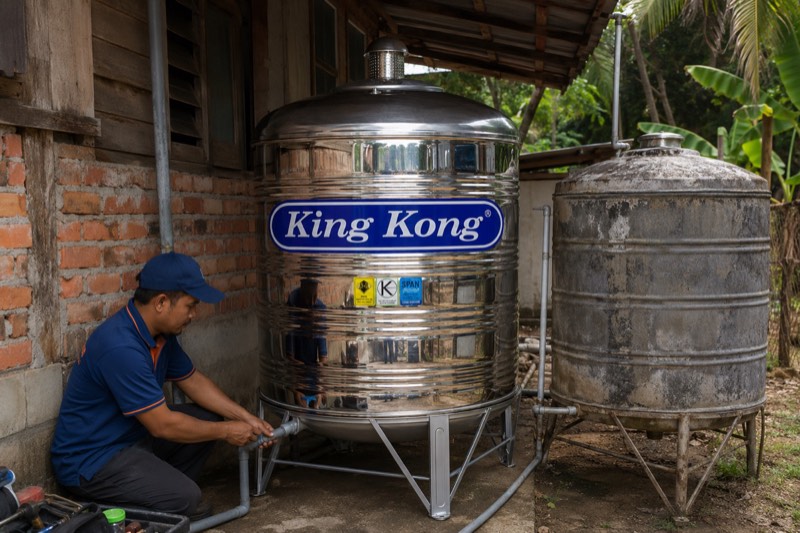
A problematic water tank always comes with the same question: is it worth repairing, or cheaper to just replace it? Answer wrongly and you either throw money at a tank that is already on its way out — or replace a tank that could have been saved with a small repair job.
This is the exact decision framework we use ourselves during site visits.
This guide covers when water tank repair is worth it, the clear signs it is time to replace, an honest cost calculation, and what happens during a site visit — so you can decide with confidence instead of guessing.
When Water Tank Repair Is the Right Answer
Repair makes sense when the problem is a component, not the tank body: a broken float valve, a worn rubber seal, a loose pipe connection, or a valve that needs replacing. These jobs cost little compared to the value of the tank, and they solve the problem completely.
Repair is also the right call for a tank that is still young — a single leak on a stainless steel tank that is only a few years old is usually an installation or connection issue, not a sign the tank is dying.
Real situations we see all the time: water overflowing through the overflow pipe (float valve), water dripping at the outlet connection (seal or fitting), and pressure suddenly going weak (valve or blocked pipe). All three look serious but are actually small repair jobs — not a reason to go straight out and spend on a new tank.
When Replacing the Water Tank Is the Cheaper Move
These are the signs that replacement is the right decision:
- Repeated leaks in different spots — the whole tank body has gone brittle; patch one place and another follows.
- A poly tank that has faded, turned chalky, or changed shape — UV damage cannot be reversed.
- Widespread rust on an old metal tank — especially at the base and the welds.
- The tank is well over a decade old — components and body reach end-of-life at the same time.
- Water stays consistently murky even after cleaning — the inner surface has degraded.
- Spare parts are hard to find — a discontinued old model turns every repair into a custom modification job.
Water Tank Float Valve: The Most Common Fault, the Cheapest Fix
If there is one component that most often causes a "problem tank", it is the water tank float valve. The symptoms are easy to spot: water overflowing out of the overflow pipe at the side of the house (the float is not shutting the valve), or the opposite — the tank never fills fully and pressure is weak (the float is stuck and shutting off too early).
The good news: this is firmly in the repair category — not a replace-the-tank situation. A float valve replacement is quick and costs very little compared to the value of the tank. The important thing is not to leave it: a faulty float that keeps overflowing wastes water every single hour and pushes your bill up without you noticing.
A quick check you can do yourself: open the water tank cover and watch the float while the tank fills — it should rise smoothly and shut off the flow at full level. If the arm is stuck, rusted, or the ball has cracked and sits half-sunk, that is the sign the component needs replacing.
The Maths: Repeated Water Tank Repair vs Replacing Once
Simple maths that many people miss: repeated patches and small repairs — each one looking cheap on its own — quickly add up past the price difference of a new tank. Then add the hidden costs: water wasted through leaks, the risk of ceiling damage, and the disruption every time a problem flares up.
For reference: a brand-new King Kong 1000L stainless steel, fully installed, RM 2,914 — with the old tank disposed of as part of the job and a 6-month installation warranty. Once your accumulated repair bills approach this figure, the decision has already answered itself.
Do not forget to count the value of your own time either: every repair session means a day waiting for the contractor, the tank drained, and your water supply disrupted. For a tank that has already failed multiple times, "settle it once" with a new tank is usually the cheapest decision once all of these costs are added together.
After Replacing Your Water Tank: A Checklist to Make It Last
If the final decision is to replace, a little discipline after installation makes sure the new tank truly lasts its full lifespan:
- Flush the first fill — fill completely, drain, refill before using the water for cooking and drinking.
- Check all connections after the first week — new connections sometimes need re-tightening after a few fill-and-drain cycles.
- Keep the water tank cover sealed at all times — block out light, leaves and insects.
- Schedule regular internal water tank cleaning, and check the float valve on every clean.
- Keep your receipt and installation records — our installation is covered by a 6-month installation warranty, and records make any claim straightforward.
How We Assess Your Water Tank During a Site Visit
Our free site visit checks four things: the condition of the tank body (cracks, rust, brittleness), the components (float valve, valves, seals), the base and stand, and the current water quality. From there we give one straight recommendation — repair with a quote for the specific work, or replace at a final fixed price.
Our principle is simple: if it is worth repairing, we repair it. We do not sell new tanks to people who do not need them — our reputation is worth more than one sale.
After the inspection, you get an answer the same day — not a "we will get back to you". If the call is repair, the quote states the specific work and the components being replaced. If the call is replace, the price given is the final fully installed price, old tank disposal included.
FAQ — water tank repair
How much does water tank repair usually cost?
It depends on the fault — replacing a float valve or seal is low-cost work; bigger piping jobs are quoted after inspection. Our site visit and quote are free — you know the full figure before any work starts.
My tank is 8 years old with one small leak. Repair or replace?
It depends on the tank type and where the leak is. An 8-year-old poly with a cracked body — consider replacing. An 8-year-old stainless with a connection issue — usually repairable. A physical inspection will confirm it.
If I replace, who disposes of the old tank?
We handle it — old tank disposal is included in every Abang Tank replacement job.
Water keeps overflowing from the pipe at the side of my house — is the tank broken?
Usually it is not the tank — that is the classic sign of a float valve failing to shut, so water keeps flowing in and straight out the overflow pipe. It is a small repair job; do not leave it, because your water bill will climb quietly.
Read Next
→ Stainless Steel Water Tank vs Poly: The Full 2026 Comparison